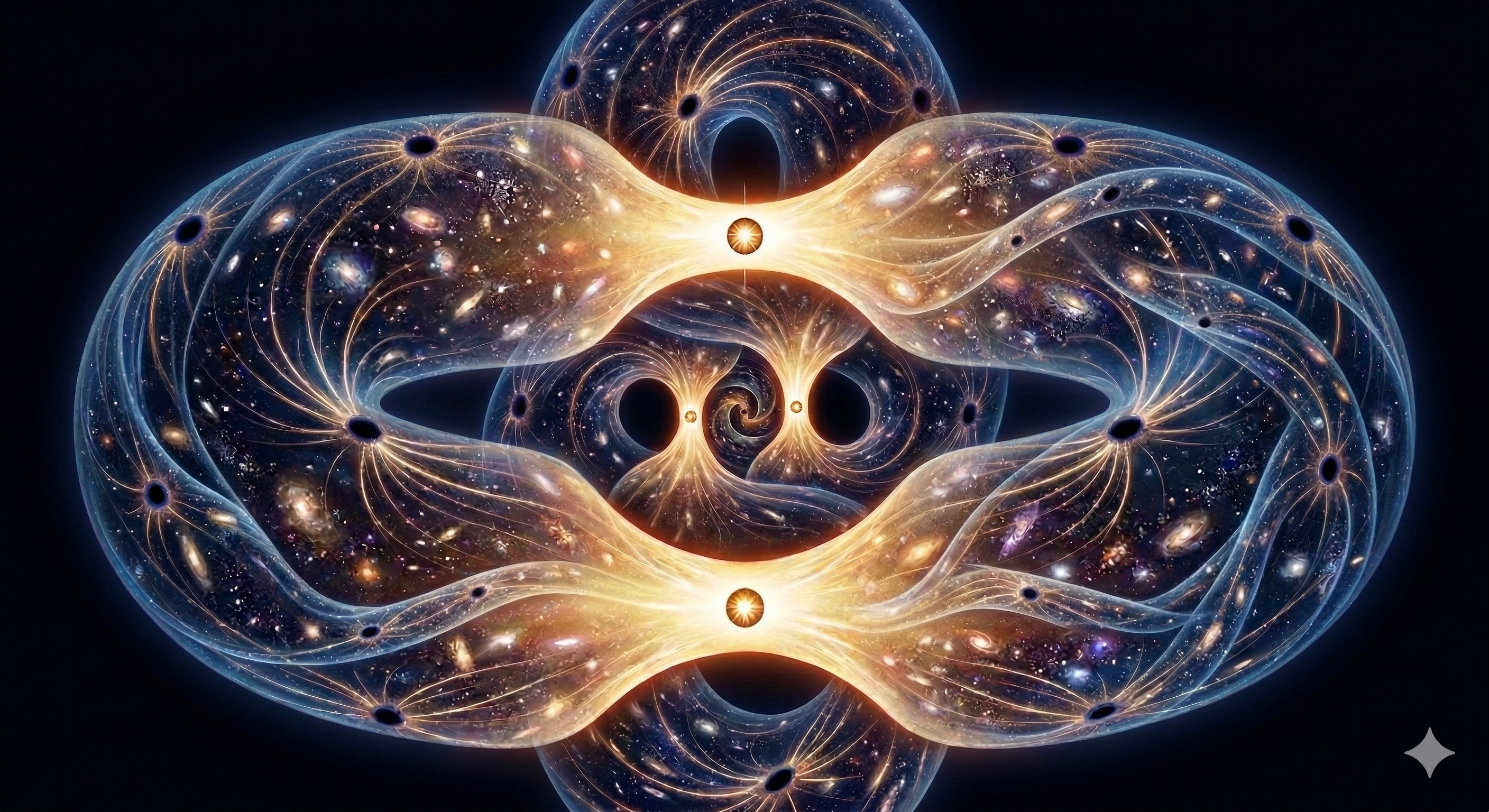
Time Is a Flat Circle
What if the question ‘what came before the Big Bang?’ is as malformed as ‘what lies beyond the edge of the Earth?’
A paper by Sancheevan Karunanithy
March 2026
For most of human history, we believed the Earth was flat. A surface with edges, beyond which lay the void. The question “what lies beyond the boundary?” felt urgent and necessary.
Then we discovered the Earth was round, and the question dissolved. There was no edge. The surface was finite but had no border. You could walk in one direction forever and arrive where you started.
We make the same mistake with time.
Act II
The Supernova Parallel
Supernova
Matter explosion in space
Gravitational collapse overcomes a star. Matter explodes into existing space.
Black Hole
Spacetime explosion into new cosmos
Gravitational collapse overcomes spacetime. New space and new time explode into existence.
“A supernova throws matter into existing space; a black hole throws new space and new time into existence. One births stars. The other births a universe.”
Eq. 1a — The Schwarzschild Metric
When r < 2GM/c², inside the event horizon, the signs of the temporal and radial terms swap. The radial coordinate becomes timelike. Time and space literally exchange their roles.
(1)Act III
Inside the Black Hole
The Inversion
Inside the event horizon, the distinction between future and past breaks down. The singularity at r = 0 is no longer a place but a moment in the future. What was once a direction in space becomes a direction in time. This is not speculative. It is a direct, uncontroversial consequence of general relativity.
The Bounce
Nature does not permit infinite compression. Loop quantum gravity predicts that collapsing matter reaches a state of maximum finite compression, forming a Planck star, and rebounds. The singularity is replaced by a transition.
Eq. 1b — The Modified Friedmann Equation
When density ρ reaches the critical density ρc ≈ 0.41 ρPlanck, the Hubble parameter drops to zero. Expansion halts. This is the bounce: maximum compression, then rebound.
(2)The Mechanism
A second, independent route reaches the same conclusion. In the Einstein–Cartan extension of general relativity, the intrinsic spin of fermionic matter generates spacetime torsion. At extreme densities, torsion acts as a repulsive force that halts collapse and produces a Big Bounce into a new closed universe.
Eq. 2a — The Torsion-Modified Friedmann Equation
The term −κ²ñ²/36 acts as repulsive gravity. At extreme densities, this torsion term dominates, the collapse reverses, and a new universe begins expanding.
(3)The Planck star: where collapse becomes expansion
The same dynamical architecture operates at two different scales: gravitational collapse overcomes resistance, then rebounds. A supernova births stars. A “spacetime supernova” births a universe.
Act IV
Every River Reaches the Sea
The deepest conjecture in this framework is that every black hole in our universe leads to the same place. They do not spawn many separate successor universes. They converge on one, because every black hole reaches the same boundary, obeys the same physics, and arrives at the same extremal state.
“Every river takes a different path, but every river reaches the sea.”
The Critical Point
Near a liquid–gas critical point, microscopic details of the intermolecular potential wash out entirely. Water and carbon dioxide share the same critical exponents despite having nothing else in common at the molecular level. This is universality. Near a critical point, the macroscopic behaviour depends only on a few relevant parameters.
We propose that the same mechanism operates at the Planck density. As matter collapses inside a black hole, the effective quantum gravity theory flows toward the Reuter fixed point, a universal attractor in the space of gravitational couplings. The individual properties of the progenitor black hole (mass, charge, spin) are irrelevant operators that get suppressed. The exit condition is universal.
Eq. 2b — The Convergence Condition
For all black holes in universe 𝒰ₙ, as density approaches the critical Planck density, the state of the system converges to the same boundary of the spacetime manifold.
(4)The Dial That Tunes Itself
If the constants of the successor universe are determined by the aggregate of everything that ever crossed a horizon, then each cycle amounts to a step in cosmic gradient descent. The process is serial iteration along a single lineage, not a genetic algorithm across parallel universes. The dials tune themselves.
Eq. 4b — Successor Constants
The fundamental constants of the next universe are determined by the total Bekenstein-Hawking entropy contributed by all black holes in the current aeon.
(4b)Act V
The Round Universe
Time curves back through the geometry of these objects and closes upon itself, finite and unbounded, like the surface of the Earth. There is no edge. No outside. A round universe needs nothing beyond itself to explain its own existence.
The Closed Temporal Manifold
Phase Transition Boundaries & Cyclical Structure
Conformal Rescaling
Two successive aeons connect at their boundaries. The infinite future of one aeon is conformally squashed to a finite hypersurface, geometrically indistinguishable from the Big Bang of the next.
Eq. 3a — Conformal Rescaling (Penrose, 2010)
The conformal factor Ω approaches zero at future timelike infinity, compactifying infinite proper time to a finite conformal boundary, which is identified with the Big Bang of the next aeon.
(6)Entropy Reset
Each Big Bang begins in a state of vanishing gravitational entropy, a smooth geometry free of irregularities. We argue that this is a consequence of convergent information aggregation at the boundary, not an axiom imposed by hand.
Eq. 3b — The Weyl Curvature Hypothesis (Penrose, 1979)
The Weyl tensor vanishes at the initial hypersurface: the boundary acts as a de-correlator, preserving the total information but erasing local structure.
(7)No Boundary
The Hartle–Hawking proposal holds that the universe has no initial boundary. In imaginary time, the manifold is compact with no edge. Hawking put it simply: asking what came before the Big Bang is like asking what is south of the South Pole.
Eq. 3c — The Hartle-Hawking No-Boundary Wave Function (1983)
The path integral runs over all compact four-geometries with no past boundary. There is no initial edge. The 'rounding off' of time is not abstract geometry but concrete physics.
(8)The Topology of Time
Linear Time
What came before? What comes after?
Round Time
No beginning. No end. No question.
Act VI
Can We Test This?
A framework that cannot be tested is not physics. The convergent model makes specific, distinguishable predictions that separate it from both Smolin’s branching model and the null hypothesis.
| Observable | Convergent | Branching | Standard |
|---|---|---|---|
| Hawking point spectra | Consistent with our physics | Shifted: different constants in predecessor | No signal |
| Fine structure constant (prev. aeon) | Identical: α ≈ 1/137 | α + δα, |δα| > 0 | N/A |
| Constants in parameter space | At extremum of BH production | On slope toward extremum | No prediction |
| CMB anomaly pattern | Rings matching known BH masses | Different mass distribution | Random noise |
The Hawking Points Controversy
Penrose and colleagues have identified circular patterns in the cosmic microwave background (CMB) that they interpret as “Hawking points”, the imprint of black hole evaporation from a previous aeon. The evidence remains contested but has not been dismissed.
Gurzadyan and Penrose reported confidence levels of 99.98%. Jow and Scott demonstrated that similar features arise in simulated Gaussian maps. An, Meissner, Nurowski, and Penrose maintained the claim with updated datasets. Meissner and Penrose (2025) provide the most recent quantitatively detailed case.
The convergent model makes the sharpest possible prediction: exact consistency with known physics. Any systematic deviation, however small, would favour branching over convergence.

Hawking point candidates overlaid on the Planck CMB all-sky map. Dashed rings mark illustrative positions of anomalous circular features (~3–4° angular diameter) consistent with black hole evaporation signals from a previous aeon.
Background: ESA and the Planck Collaboration, CC BY-SA 3.0 IGO. Ring annotations are illustrative.
When We Will Know
CMB-S4 (early 2030s) will achieve noise levels roughly an order of magnitude below current surveys. LiteBIRD (launch 2032) will provide full-sky polarisation maps at sufficient sensitivity to confirm or exclude the signal at high confidence. A model that predicts exact agreement with known constants is more falsifiable than one that predicts small but unspecified deviations. That falsifiability is a virtue, not a liability.
Act VII
It Just Is
The Problem of Origins Is Dissolved, Not Solved
This is a fundamentally different kind of resolution: the difference between failing to answer a question and discovering that the question contains a false assumption.
Fine-Tuning Explains Itself
Nobody tuned the dials. The dials tuned themselves through gradient descent on a cosmic scale.
Black Holes Are Reproductive Organs, Not Graves
Nothing is lost. Everything is recycled, not within our universe but through it, into the next.
The Information Paradox Is Reframed
Information passes through the bounce into the successor spacetime. The holographic encoding on each horizon and the transmission through the bounce are complementary: the horizon encodes what the bounce transmits. Every particle that ever crossed an event horizon contributed to the initial conditions of the next universe.
The Arrow of Time Is Local, Not Cosmic
In a temporally closed universe, the arrow of time is real but local. Heat death is never reached because it is the precondition for the next Big Bang.
Endings Are Transitions
The matter and energy that composed you will eventually cross an event horizon, pass through a bounce, and participate in the initial conditions of a new cosmos. It will not be you, but it will not be nothing either.
If the universe is round, with no beginning, no end, no outside, and no need for external explanation, then we are not at the centre of a story and we are not the point of one. We are a brief, local, beautiful eddy in a process that has no edge, no author, and no conclusion.
We exist because the universe exists. The universe exists because existence is what a closed topology does. And within that closed topology, for a few billion years on a small rocky planet, matter became aware of itself and asked why.
The answer is that the question only exists because the universe is the kind of thing that produces beings who ask it. Not as a purpose, but as a consequence. And consequences are enough.
“The universe is round. A round universe needs nothing outside itself to explain its own existence. It just is.”